Nella lezione di Reti di Calcolatori di oggi abbiamo accennato ad un argomento che non è parte del corso, cioè le catene di certificati.
Nel corso abbiamo detto che la chiave pubblica di un Subject viene ottenuta sempre attraverso un certificato emesso da un Issuer che deve già essere presente nel KeySet e nel TrustSet di chi utilizza quel certificato.
Nella realtà accade quasi sempre una cosa più complicata: invece di un certificato arriva una sequenza di certificati in cui:
Solo il Subject=Issuer del primo certificato è nel KeySet e nel TrustSet (il primo certificato della sequenza deve cioè essere già presente nel software di chi usa la catena).
Intuitivamente, la CA che ho già nel KeySet e TrustSet delega un'altra CA-1 a rilasciare certificati; il fatto che io mi fidi di CA implica (trascurando qualche dettaglio) che mi fidi anche di CA-1. Poi CA-1 delega un'altra CA-2 e così via, fino ad arrivare al Subject finale che è certificato da una CA-X che non c'entra nulla con quella nel KeySet e TrustSet. La mia fiducia (implicita) in CA-X è una conseguenza logica della mia fiducia in CA.
Durante la lezione ho cercato di visualizzare una di queste catene ma come mi accade spesso non ci sono riuscito. In realtà è semplicissimo. Il certificato visualizzato dal browser è l'ultimo della catena, ad esempio, nel caso di Gmail:


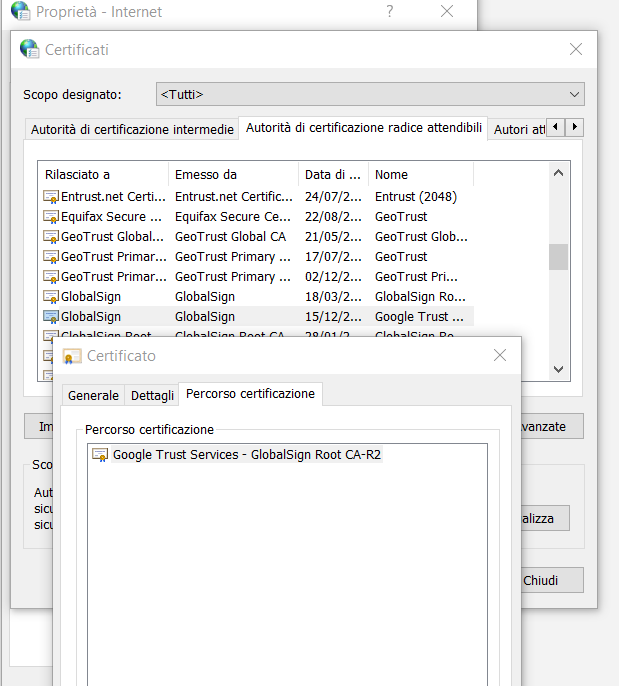
Andando a scavare nel TrustSet / KeySet di Windows 10 si trova, con un pò di pazienza, il certificato autofirmato che costituisce la "anchor" della catena, cioè l'atto di fede su cui si basa tutto il resto.

Nel corso abbiamo detto che la chiave pubblica di un Subject viene ottenuta sempre attraverso un certificato emesso da un Issuer che deve già essere presente nel KeySet e nel TrustSet di chi utilizza quel certificato.
Nella realtà accade quasi sempre una cosa più complicata: invece di un certificato arriva una sequenza di certificati in cui:
- Lo Issuer dell'ultimo certificato della sequenza è il Subject del penultimo certificato;
- ...
- Lo Issuer del k-esimo è il Subject del (k-1)-esimo;
- ...
- Il primo certificato della sequenza è self-signed.
Solo il Subject=Issuer del primo certificato è nel KeySet e nel TrustSet (il primo certificato della sequenza deve cioè essere già presente nel software di chi usa la catena).
Intuitivamente, la CA che ho già nel KeySet e TrustSet delega un'altra CA-1 a rilasciare certificati; il fatto che io mi fidi di CA implica (trascurando qualche dettaglio) che mi fidi anche di CA-1. Poi CA-1 delega un'altra CA-2 e così via, fino ad arrivare al Subject finale che è certificato da una CA-X che non c'entra nulla con quella nel KeySet e TrustSet. La mia fiducia (implicita) in CA-X è una conseguenza logica della mia fiducia in CA.
Durante la lezione ho cercato di visualizzare una di queste catene ma come mi accade spesso non ci sono riuscito. In realtà è semplicissimo. Il certificato visualizzato dal browser è l'ultimo della catena, ad esempio, nel caso di Gmail:

Il tab "percorso certificazione" mostra una sintesi della catena:

Andando a scavare nel TrustSet / KeySet di Windows 10 si trova, con un pò di pazienza, il certificato autofirmato che costituisce la "anchor" della catena, cioè l'atto di fede su cui si basa tutto il resto.
A questo punto iniziano infinite domande "ma i certificati intermedi possono essere inseriti nel KeySet? e nel TrustSet? e se dopo mi arriva dall'esterno uno diverso? e se viene revocato un certificato nella catena? e se un Issuer nella catena è già nel mio KeySet ma con una chiave diversa?". E così via.
La quantità di problemi insiti in questa faccenda è una ulteriore dimostrazione della verità di quella frase che ho mostrato a lezione ed attribuito al quasi-Sheva&Kakà, "chiunque affermi che un problema è risolto facilmente dalla crittografia, dimostra di non avere capito il problema".
Commenti